
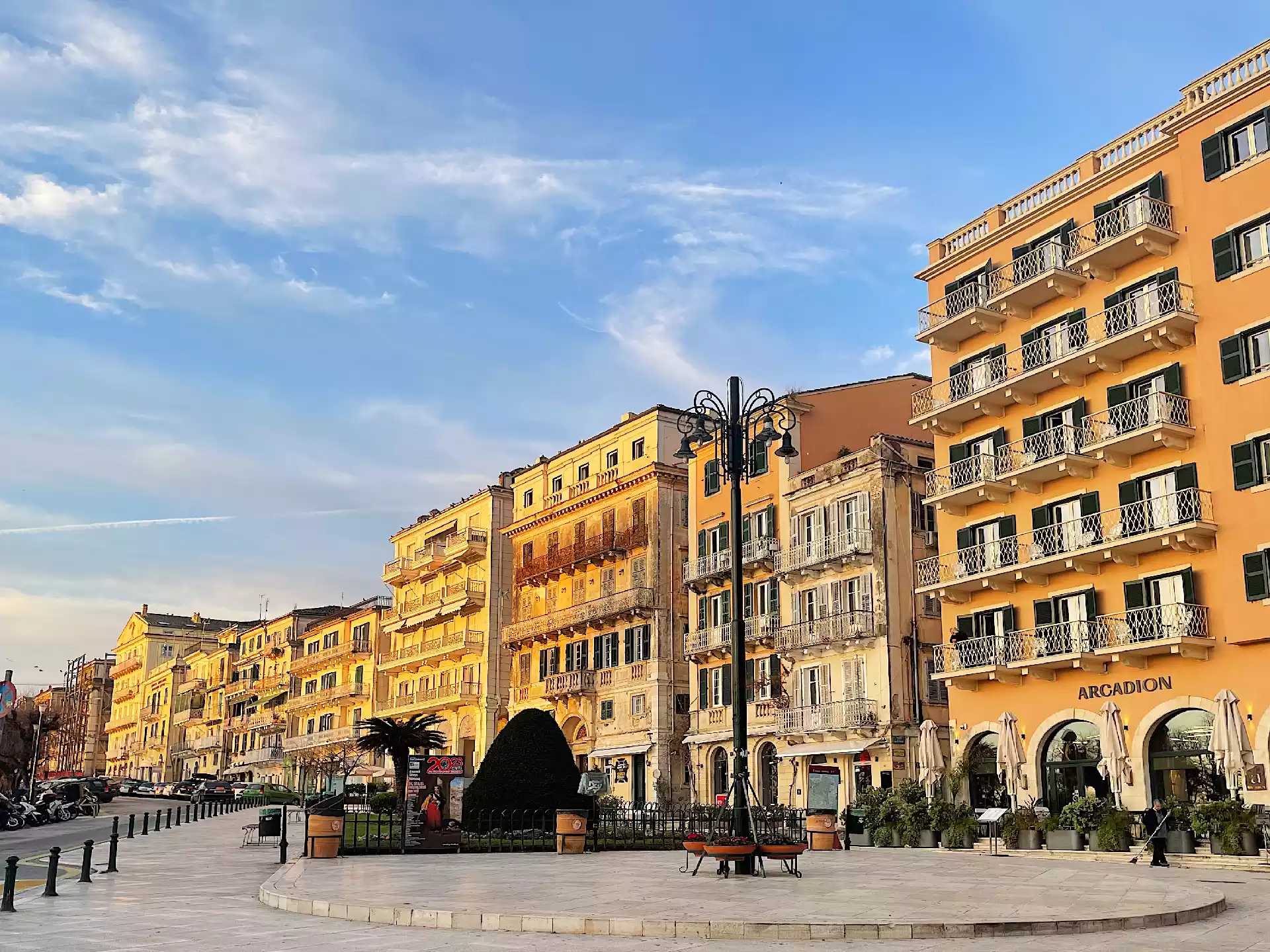
Corfu Old Town is a historic district located in Kerkyra, the capital of the Ionian Islands and the island of Corfu in Greece.
In 2007, the area was added to the UNESCO World Heritage list due to its cultural and historical significance.
The Old Town of Corfu is considered one of the best-preserved examples of Venetian urban planning and architecture in Europe, dating from the period of Venetian rule between the 15th and 18th centuries.
How big is Corfu Old Town?
The Old Town of Corfu consists of more than 1,500 historic buildings, narrow cobblestone streets, small squares, churches, two fortresses, shops, cafés, and residential houses.
Some of them are still inhabited by locals, but the majority of apartments in the old town are used as short-term rentals for guests of the island and stay empty out of season.
The protected UNESCO zone covers around 70 hectares.
You can pleasantly explore Corfu Old Town and its maze-like alleys, known as kantounia (καντούνια), properly without the need for transport.
Important note: When going for your Corfu Old Town walk, wear comfortable shoes with a stable and thick sole.
The cobblestones inside the old town are quite slippery, especially after the rain, and uneven surfaces can strain your feet because of the deep gaps between the stones.
Corfu Old Town Walking Tour Duration
To properly explore the whole Old Town of Corfu slowly and actually feel it, not just pass through, you need approximately 3 to 4 hours on foot.
The Old Town is compact, but very dense with detail, so the experience is more about pausing and observing than covering distance.
If you also want to see the main fortifications of the island, the Old Fortress tour will take 2 to 3 more hours, and the New Fortress will add another hour to your Corfu Old Town tour.
While literally every building in Corfu Old Town is a UNESCO architectural monument, there are some specific areas that define the essence of the Old Town’s atmosphere.
Signature highlights like…
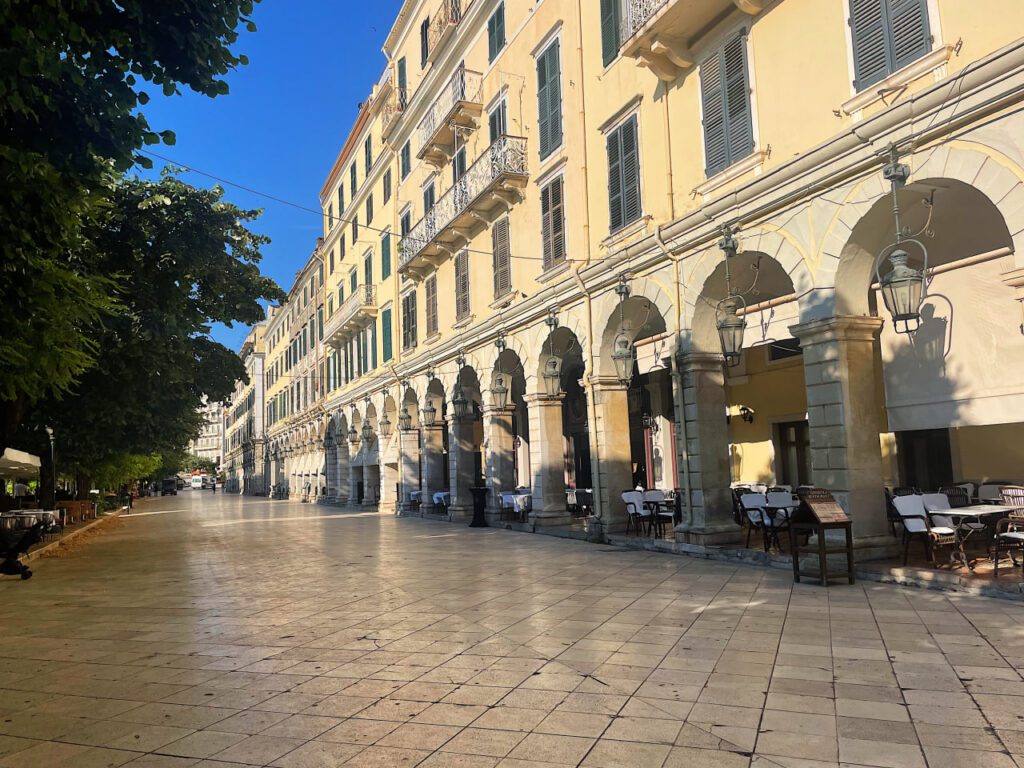
Liston Promenade: The Most Popular Landmark of Corfu Old Town
Liston is a wide promenade in a neoclassical style, built by the French during Napoleonic rule between 1807 and 1814.
Even though it looks like the alley consists of many individual buildings, the Liston was designed as a single, cohesive architectural ensemble.
In fact, it is just one long building.
The Liston in Corfu was inspired by the famous Rue de Rivoli in Paris, but it received its current name only in the 19th century.
The name “Liston” comes from the Venetian word liston, which means a wide, straight stone alley used for walking (or a list of nobility).
Even though the French and British built the promenade, the name given to the landmark by locals is Venetian.
400 years of prior Venetian rule on Corfu (1386–1797) deeply influenced the local language and traditions.
Although Corfu Liston is the most famous, there are several other streets and squares called Liston in Italy.
There are listons in Venice, Verona, Padua, Belluno, also in Rovig, Trieste, Ferrara, Mirandola and some others.
Interesting fact: Initially, the French built only the lower level of the Liston building.
The floors for residential apartments were built a few years later during the British Protectorate.
The Heart of Corfu Old Town: Campiello
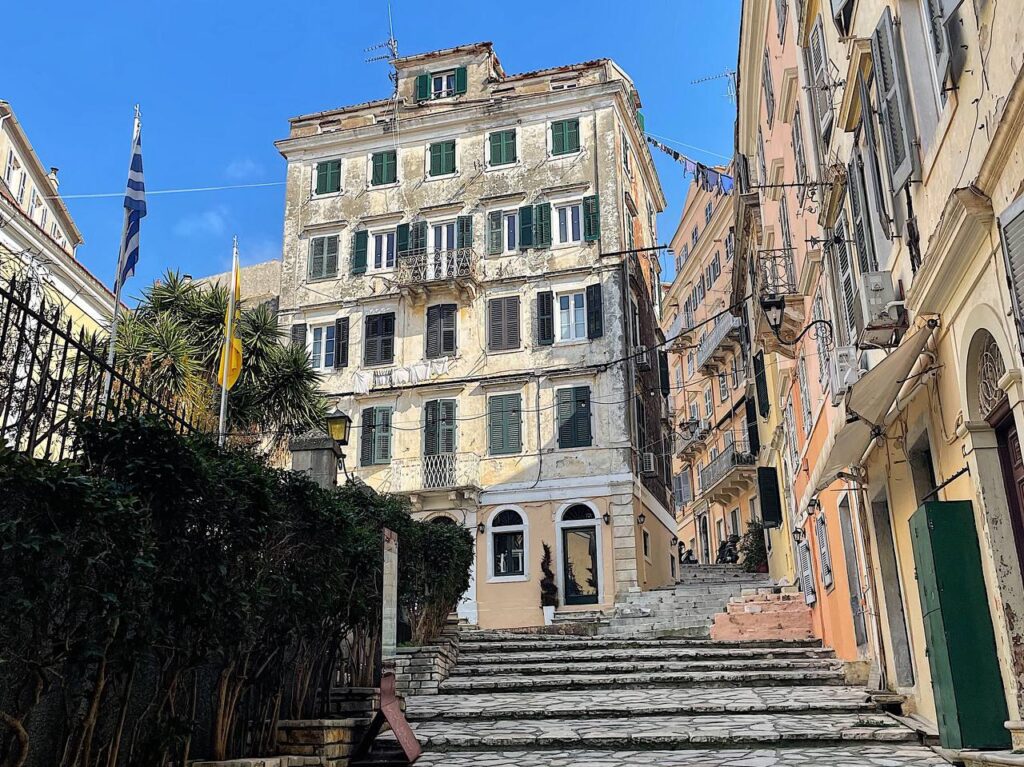
Campiello is the oldest and most atmospheric quarter of Corfu Old Town.
The name Campiello comes from the Venetian word campiello, which means “small neighborhood square”.
Campiello began to develop as the population of Corfu expanded beyond the confines of the Old Fortress during the medieval period, around the 14th and 15th centuries under Venetian rule.
It is considered the first major settlement outside the walls of the Old Fortress. Because of this, Campiello is often referred to as the heart of the Venetian heritage of Corfu.
Campiello is a maze of narrow alleyways, small squares, tall pastel-colored buildings, hidden courtyards, historic centuries-old churches, and Venetian wells.
Walking through the quarter, you will find Gothic details, decorative stone carvings known locally as moroi (μωρόι), many inner courtyards and closely packed houses built within the tight confines of the fortified city.
It still retains an authentic atmosphere. Unlike many parts of Corfu Old Town that have become heavily commercialized, Campiello remains a living neighborhood where residents still occupy many of the buildings.
The hanging laundry, cats, flower-filled balconies, and quiet squares are all essential elements of the unique charm of Corfu Old Town.
Spianada Square (Plateia)
Spianada, or Plateia, is the largest square in Greece and one of the largest public squares in Europe.
Covering approximately 42,000 square metres, Spianada is almost twice the size of Syntagma Square in Athens and more than three times larger than Trafalgar Square in London.
Its development began in 1537 under the Venetian military engineer Michele Sanmicheli, following the devastating Ottoman siege of Corfu.
To strengthen the defences of the Old Fortress, the Venetians cleared and widened the open area in front of its walls, creating a vast defensive zone.
This open, flat space gave the fortress cannons a completely unobstructed line of fire against approaching enemies while preventing invading forces from advancing unnoticed.
To achieve this, thousands of local homes were demolished.
Spianada in Corfu acquired its present appearance during the French period (1807-1814), when it was transformed from a purely military zone into a public space.
Around the same time, rows of trees were planted, creating the elegant promenade that remains one of Corfu’s defining landmarks.
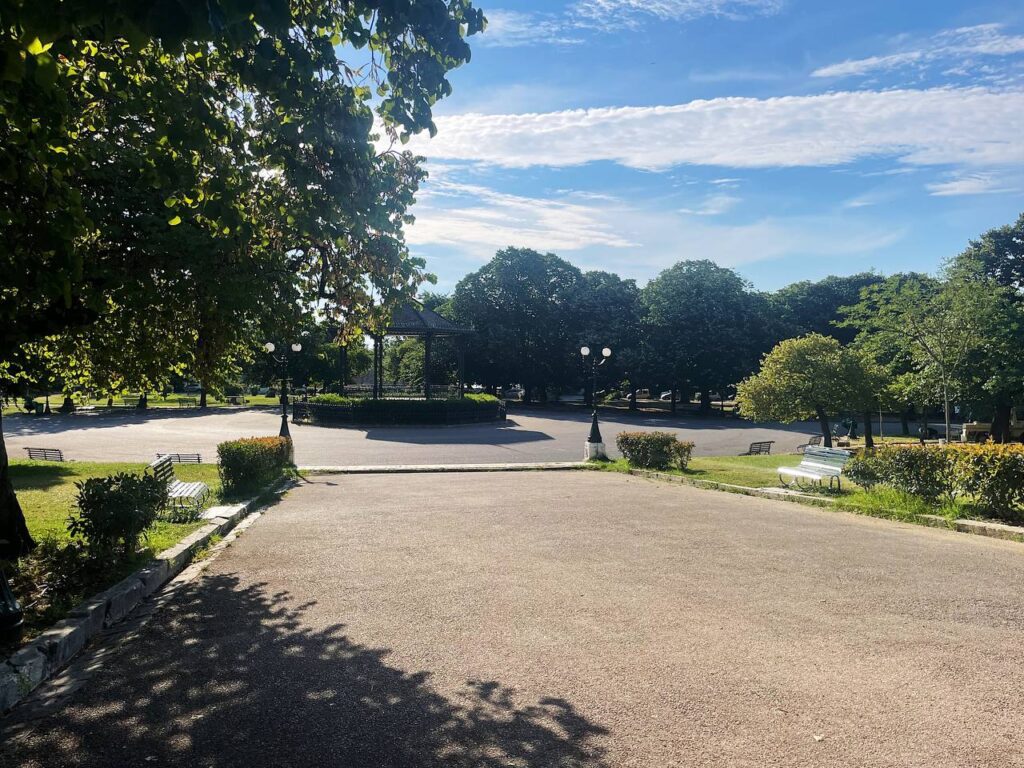
Spianada is unofficially divided into Upper and Lower Squares.
The Lower Square (Kato Plateia), adjacent to the Liston Arcade, is home to the largest cricket field in Greece.
Introduced by the British during their rule of the island, cricket quickly became popular among the local population.
So popular that Corfu eventually became the centre of Greek cricket, and to this day it remains the headquarters of the Hellenic Cricket Federation, with most of the country’s cricket clubs and national team activities based on the island.
The Upper Square (Pano Plateia) features the elegant neoclassical bandstand, known locally as Palko (Πάλκο).
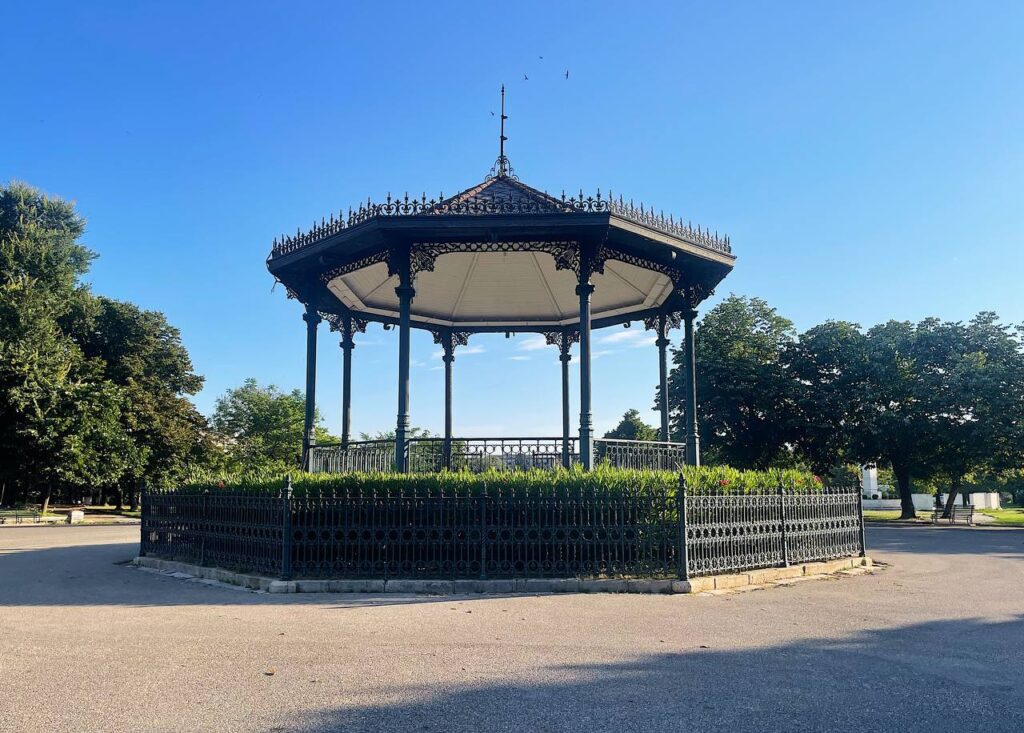
It was built in 1913 by the Municipality of Corfu using funds of the prominent Corfiot benefactor Georgios Zampelis, who left a substantial part of his fortune to support major public works and the modernisation of the island.
The bandstand was designed by the Corfiot architect Andreas Sgouros, who was actively involved in the island’s urban development during the early 20th century.
His design reflects the elegant neoclassical style that characterised many public works of the period in Corfu and remains one of the most recognisable landmarks of Spianada Square.
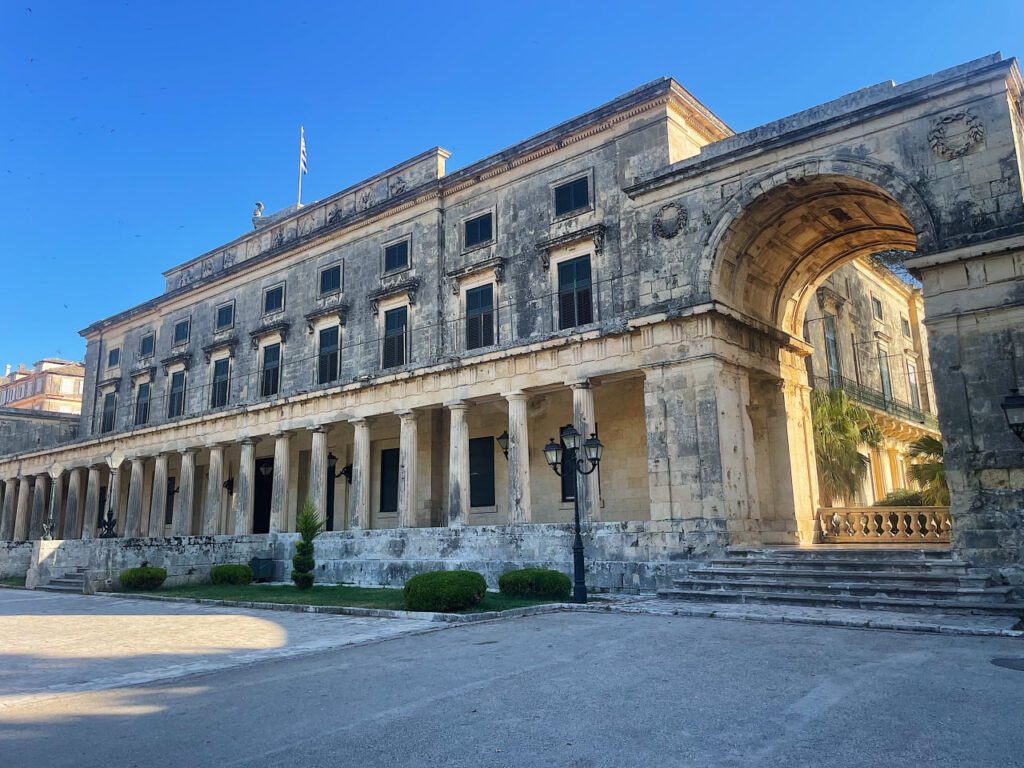
Palace of St. Michael and St. George & Its Gardens
Surrounded by defensive walls built by the Venetians in the 16th century, nowadays this grand palace with a Doric colonnade houses the Museum of Asian Art and exhibitions of the Corfu Municipal Gallery.
The building itself was erected between 1819 and 1824 during the British Protectorate in Corfu.
Initially, it served as the luxurious residence of the British Lord High Commissioner and, at the same time, the seat of the Ionian Senate.
After the Ionian Islands were reunited with Greece in 1864, it became a royal palace used by the Greek royal family as a summer residence.
If you overlook the sea and the Old Fortress from the gardens of the Palace of St. Michael and St. George, you will find a winding wrought-iron aerial staircase called the “Queen’s Ladder.”
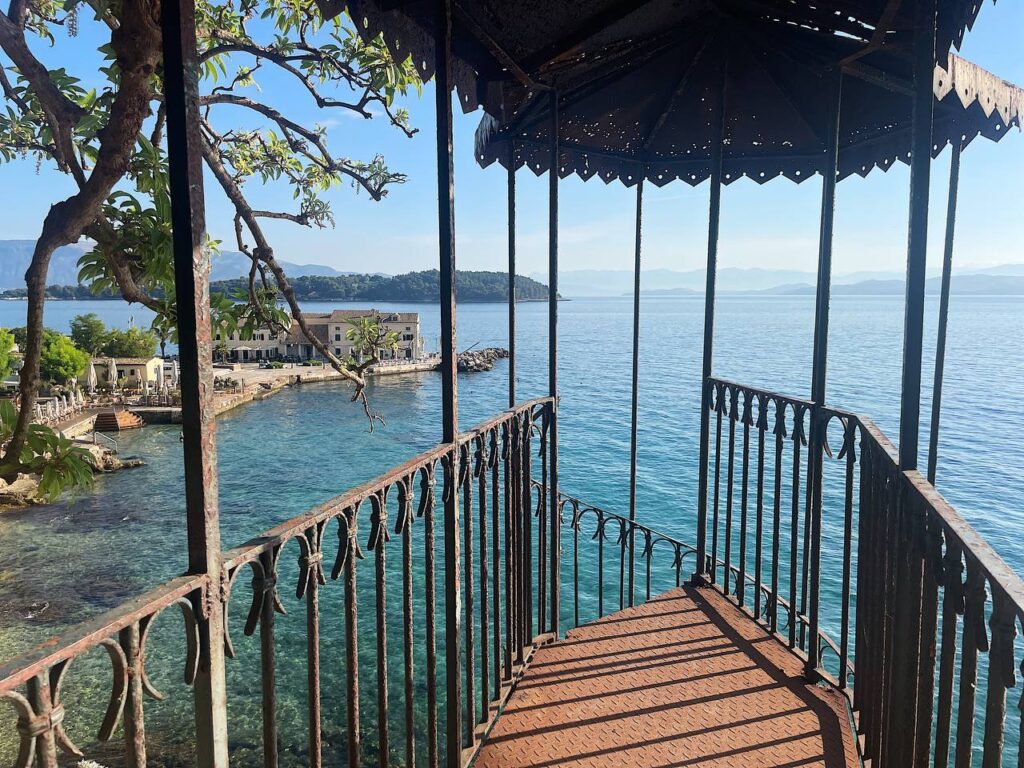
Back in time, it was used by royalty to descend directly from the palace down to the sea.
The public gardens of St. Michael and St. George are artworks in themselves.
The lush, green, flower-filled surroundings serve as a perfect frame for the stone sculptures.
Because the rear side of the palace houses the Municipal Art Gallery of Corfu, the gardens operate as a unique open-air gallery themselves, featuring contemporary abstract stone sculptures placed along their paths.
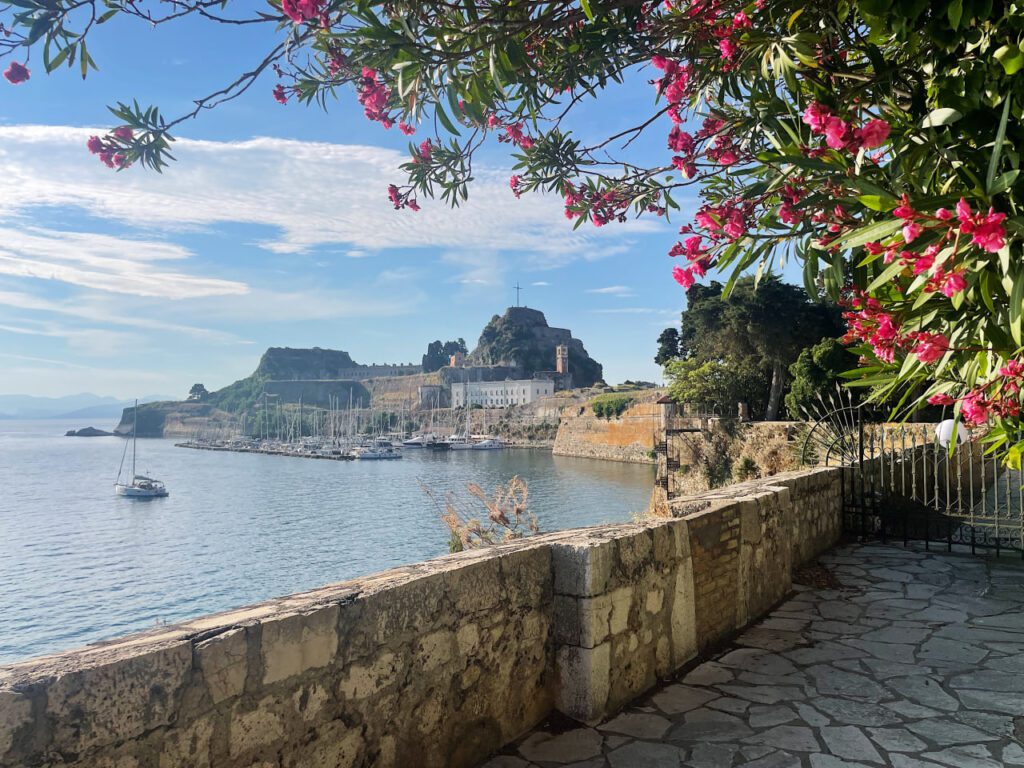
Old and New Fortresses of Corfu
The Old Fortress of Corfu was a massive fortification complex and the core of the famous defensive network of the island.
It was originally a Byzantine structure dating back to the 6th century, but the Venetians heavily rebuilt and reinforced it during the 15th century to protect the town from Ottoman invasions and pirate raids.
The Old Fortress is a huge maze of fortifications, hidden tunnels, lookouts, old barracks, and military structures.
There is also the Church of Saint George inside the Old Fortress of Corfu.
Built by the British in 1840 to serve their garrison soldiers, this church is completely unique.
Because it was designed in the Neoclassical style with striking Doric columns, it looks exactly like an ancient Greek temple rather than a traditional Orthodox church.
Thanks to this, it has unique acoustics and often hosts classical music concerts and art performances.
The fortress also houses the island’s Public Library and the Department of Music Studies of the Ionian University, which is located inside the former military barracks.
Visitor Tip: To explore the Old Fortress of Corfu properly, you will need about 2.5 to 3 hours.
Opening Hours: Daily from 08:00 to 20:00 during the summer season (April to October), and from 08:30 to 15:30 during the winter.
Ticket Price: €10 for a standard ticket (€5 reduced). Official info can be found on the Ministry of Culture Old Fortress page.
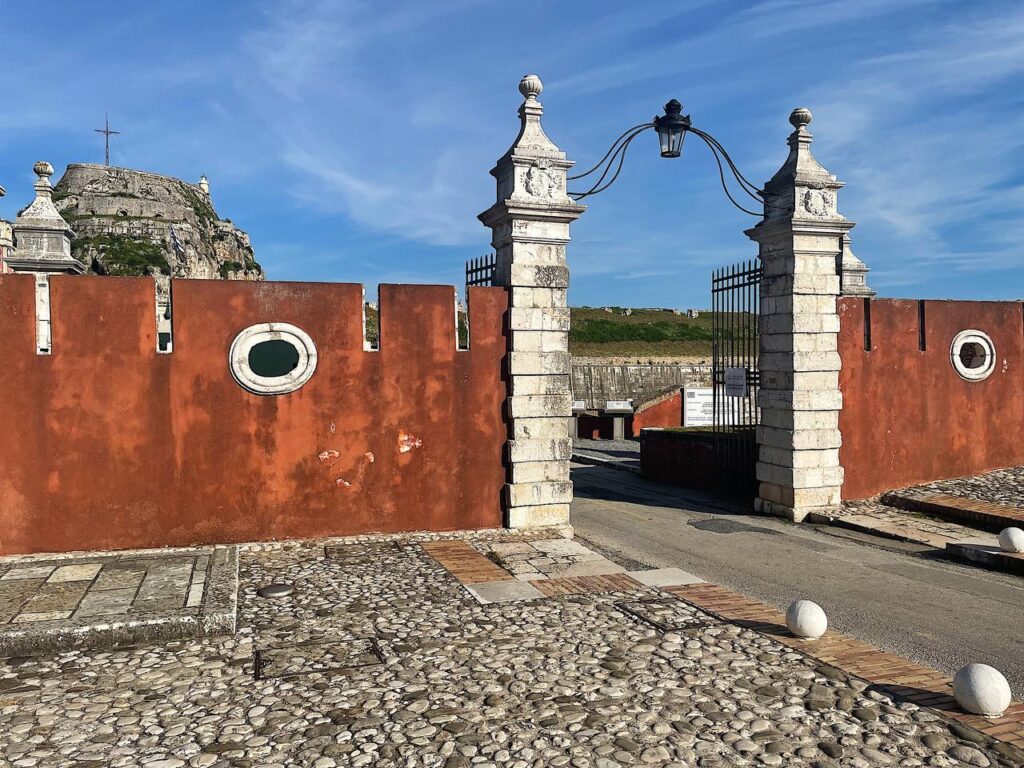
The New Fortress was built by the Venetians in the late 16th century to reinforce the town’s defences and act as a stronghold protecting the harbour.
The Venetians realized that a single fortress would not be able to protect the growing city efficiently from Ottoman threats.
They designed a sophisticated two-level structure—the lower level to protect the port and the upper level to defend the city.
They connected it to the Old Fortress via a network of maze-like underground military tunnels and built a unified defensive wall that wrapped tightly around the city’s perimeter.
Nowadays, the New Fortress functions as a protected historical site under UNESCO World Heritage auspices.
At the same time, it houses a fully functioning Hellenic Navy station within its grounds.
Visitor Tip: Allow approximately 1 hour to explore the New Fortress.
If you enjoy photography and panoramic viewpoints, plan to spend up to 1.5 hours.
Be careful when planning your visit, as the New Fortress has limited opening hours.
It is generally open daily during the summer season from 08:30 to 15:30, but it is closed on Tuesdays (and completely closed to the public during the winter months).
Ticket Price: €5 for a standard ticket (€3 reduced). Official info can be found on the Ministry of Culture New Fortress page.