
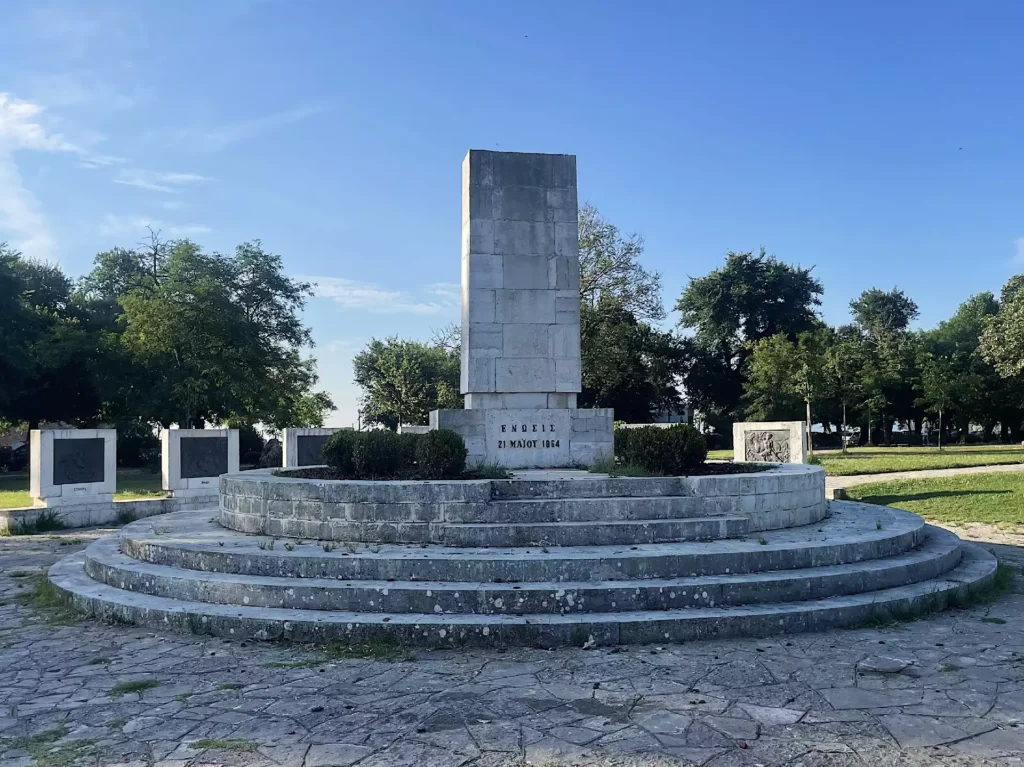
Right in the center of Spianada Square in Corfu Old Town stands the Monument of the Union of the Ionian Islands.
Despite its prominent location and striking appearance, it is rarely mentioned in travel guides.
Perhaps that’s why many visitors walk right past it, overlooking it entirely.
The monument was commissioned to mark the 100th anniversary of the Union of the Ionian Islands with Greece, which formally ended British rule in 1864.
Creators
The elegant white Pentelic marble monument was conceived and designed by the distinguished Corfu architect and conservation specialist Nane Kollas, who envisioned it as a lasting symbol of the Union of the Ionian Islands with Greece.
The seven relief plaques were sculpted by the renowned Corfu born artist Rena Croizier.
When she received the commission, she was only 25 years old, and the monument became her very first sculptural work.
Inspired by the mythology and ancient coinage of each Ionian island, Croizier created a unique symbolic relief for every plaque.
Every relief was designed exclusively for this monument after extensive historical and mythological research, rather than being copied from earlier artworks.
The creation of the seven reliefs required seven years of meticulous study, research, artistic design, and engraving before they were ready for casting.
The monument itself was completed in 1972.
However, it was officially inaugurated only in 1974, following the fall of the Greek military dictatorship.
The monument is made primarily of Pentelic marble, the same legendary stone used to build the Parthenon and many of the monuments on the Acropolis of Athens.
Its relief plaques were cast in metal and mounted onto the marble panels, a material chosen not only for its durability but also for its ability to preserve intricate artistic details for generations.
The Union with Greece
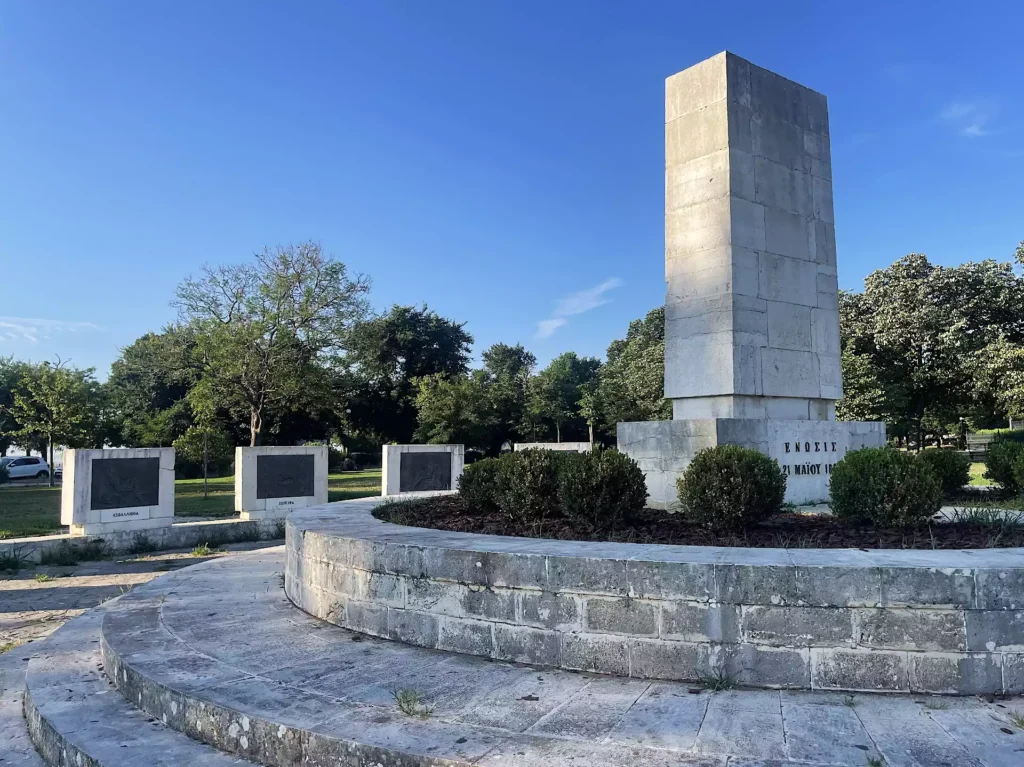
At the heart of the monument stands a simple marble obelisk engraved with the date 21 May 1864, the day the Ionian Islands officially united with Greece, surrounded by a circular plaza.
The story behind this monument is quite interesting.
Britain did not lose the islands through war.
Instead, it formally ceded the Ionian Islands to Greece as a diplomatic gift celebrating the accession of the young Danish Prince William, who became King George I of Greece.
Seven Islands and Greek Mythology
Set into the stone around the plaza are seven bronze relief plaques.
Each of them represents one of the major Ionian Islands.
Together, these islands are historically known in Greece as the Heptanese (Επτάνησα), which literally translates as “The Seven Islands.”
Each plaque represents one of the seven islands and tells a story from Ancient Greek mythology and local history associated with it.
Decoding the Seven Symbols
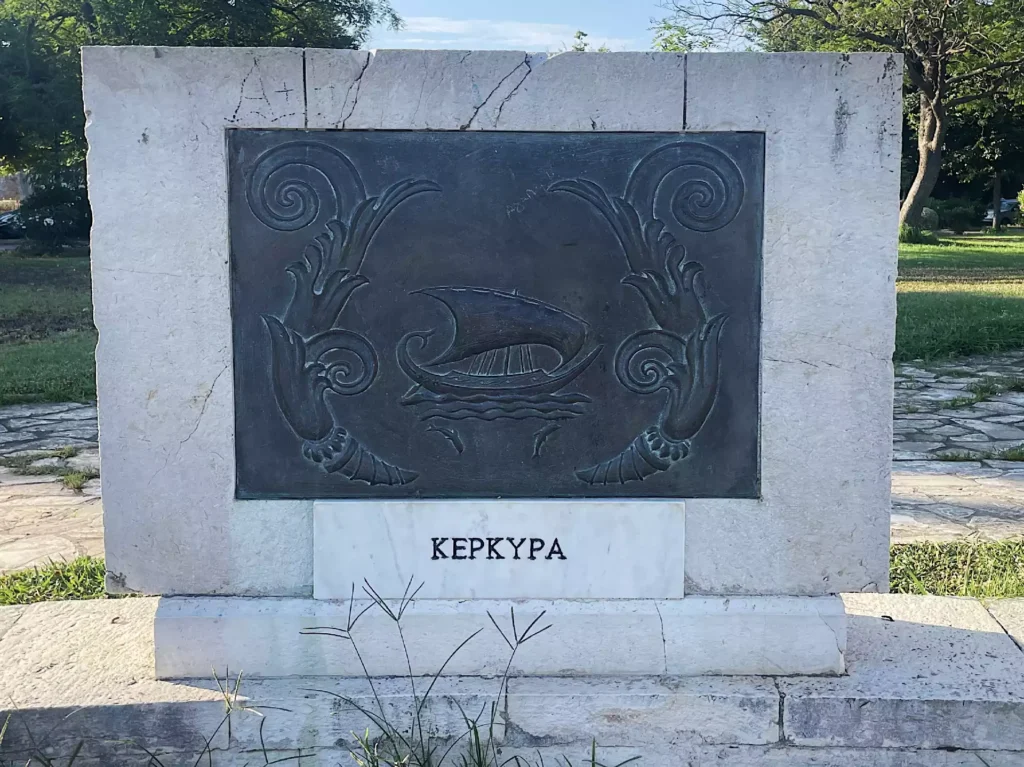
Corfu (Κέρκυρα) – The Rudderless Ship
Kerkyra is represented by an ancient ship without a rudder.
According to Homers Odyssey, the Phaeacians, the mythical people of Corfu, were such exceptional sailors that their ships were said to possess almost magical intelligence.
They needed neither rudder nor helmsman, as the vessels could navigate by the thoughts and intentions of their crew.
Interestingly, many visitors do not realize that Corfu is the historical and administrative capital of the Ionian Islands Region.
This is why its plaque occupies the central position on the monument, aligned with its main axis.
Throughout history, Corfu became the leading island of the Heptanese thanks to its mighty fortifications and strategic location at the entrance to the Adriatic Sea.
For centuries, it served as the political, military, and cultural center of the Ionian Islands, particularly during Venetian rule.
Paxi (Παξοί) – The Trident of Poseidon
The plaque depicts the trident of Poseidon, the iconic three pronged spear of the Greek god of the sea.
According to legend, Poseidon struck the southern coast of Corfu with his trident, breaking off a piece of the island to create Paxi as a peaceful retreat for himself and his beloved wife, Amphitrite.
Ithaca (Ιθάκη) – Odysseus
The plaque depicts the profile of Odysseus, the legendary king of Ithaca and hero of Homer’s Odyssey, wearing his signature traveler’s cap, the pileus.
Ithaca was the homeland to which Odysseus struggled to return after the Trojan War.
His ten year journey became one of the greatest stories of perseverance, intelligence, and loyalty in Greek mythology, forever linking the island with his name.
Cephalonia (Κεφαλονιά) – Cephalus and Laelaps
The plaque portrays the legendary hunter Cephalus alongside Laelaps, the mythical hound destined never to fail in catching its prey.
According to mythology, Cephalus became the first ruler of the island, which was later named in his honour.
Zakynthos (Ζάκυνθος) – Prince Zakynthos
The plaque honours Prince Zakynthos, the mythical son of Dardanus, the legendary founder of Dardania.
According to ancient tradition, he sailed from the Peloponnese and established the first settlement on the island, giving Zakynthos its name.
Lefkada (Λευκάδα) – Pegasus
The plaque depicts the hero Bellerophon riding the winged horse Pegasus, symbolising courage, freedom, and heroic ambition.
The image also alludes to the spectacular white cliffs of Cape Lefkatas, whose brilliant limestone gave the island its name, which comes from the Greek word lefkos, meaning “white.”
Kythira (Κύθηρα) – Aphrodite and the Dolphin
The plaque depicts Aphrodite, the goddess of love, accompanied by a dolphin, a traditional symbol of the sea.
According to one of the oldest Greek traditions, Aphrodite was born from the sea foam and first arrived at Kythira before continuing her journey to Cyprus, where her cult later flourished.
For this reason, Kythira is regarded as one of the sacred islands of Aphrodite.
The dolphin emphasizes the island’s close connection with the sea and the maritime origins of the goddess.
More Than a Monument
When you visit Corfu, or the next time you stroll across Spianada, pause for a moment and step onto this marble circle.
Instead of simply passing by, take a closer look at these seven bronze symbols.
They are far more than decorative plaques.
Together, they form a visual map of the myths, history, and enduring Ionian spirit that unite the seven islands.
Moreover, this is the principal, and effectively the only, monument dedicated to the Union of the Ionian Islands with Greece.
It also serves as the focal point of the official commemorations held every year on 21 May, marking the anniversary of the Union in 1864.